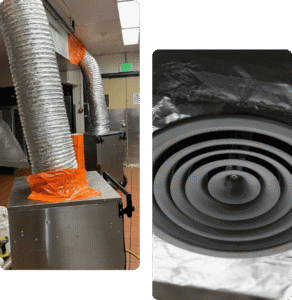
Commercial HVAC systems circulate air through offices, classrooms, retail stores, and medical facilities all day. Multiple HVAC units and extensive ductwork distribute that air throughout the building, often hidden above ceilings. Cleaning a system like that takes more planning than a home job, since the building stays in use and the people inside need to stay protected while the work happens.
Commercial air ducts are cleaned through a planned process that removes dust and debris from the entire HVAC system while keeping the building safe for the people inside. Technicians loosen buildup from duct surfaces and pull it out under negative pressure, then clean the air handlers and confirm the system is clean before it goes back into service.
The exact approach depends on the building’s size, how it’s used, the duct materials, and the level of contamination. For property managers planning commercial duct cleaning in Toms River, knowing these steps makes it easier to understand what a complete job includes.
The Commercial Duct Cleaning Process Step by Step
Every commercial project follows the same seven-phase sequence, even when the building and scope change:
- Inspect and Assess the System: Check air handlers, ducts, and internal components to decide what needs cleaning.
- Build the Work Plan and Schedule: Define the scope, methods, and safety steps, and plan the work around business hours.
- Protect Occupants and the Building: Set up containment to keep dust out of occupied areas.
- Clean the Ductwork and Commercial Components: Shut down the system, apply negative pressure, and clean ducts, VAV boxes, dampers, plenums, and rooftop units.
- Clean Air Handlers and Coils: Clean coils, fans, drain pans, and housings.
- Restore the System: Close service openings, reset dampers, and reinstall grilles.
- Verify and Document the Work: Confirm surfaces are clean and record the results.
Phase 1: Inspecting and Assessing the System
Every commercial project starts with an inspection. It tells the contractor whether cleaning is needed, what the scope should be, and which tools and safety controls the job requires.
The inspection covers the full air path through the building:
- Air-Handling Units: Filters, coils, condensate pans, drain lines, fans, dampers, and insulation.
- Supply Ducts: Main ducts, mixing or control boxes, reheat coils, and other internal parts.
- Return Ducts: Return air ducts, dampers, plenums, and grilles.
- Exhaust Ducts: General exhaust, restroom exhaust, and heat recovery exhaust.
Inspectors also review building and mechanical drawings when they’re available, since commercial ductwork often runs through ceilings and shafts that can’t be seen from the floor. If suspected mold turns up, a qualified indoor environmental professional may be brought in to assess its cause and extent before cleaning begins.
Phase 2: Building the Work Plan and Schedule
Commercial cleaning runs on a written plan. The work plan gives the building owner, facility manager, and cleaning crew the same understanding of what will happen, when, and how.
What the Work Plan Covers
A complete plan answers these questions before work begins:
- Scope of Work: Which components will be cleaned, and which are not included.
- Methods: How each part of the system will be cleaned.
- Schedule: Dates, times, and the overall timeframe.
- Special Requirements: Power, water, lifts, or roof access.
- Chemical Products: Any products used, with Safety Data Sheets.
- Life Safety Plan: How duct smoke detectors and sensors will be handled if they need to go offline.
- Excluded Systems: Kitchen grease exhaust ducts follow separate fire code cleaning rules and are usually handled as their own project, so the plan should state whether they’re included.
NADCA‘s General Specifications for commercial HVAC cleaning set the minimum requirements for coordinating this kind of project and are written for building owners, managers, and engineers.
Scheduling Around Business Hours
Most commercial buildings can’t shut down for a full day. Cleaning is often split into zones, floors, or air handlers and completed after hours, overnight, or on weekends.
Phase 3: Protecting Occupants and the Building
Dust released during cleaning must stay out of occupied spaces. Commercial projects use engineering controls, a term for the physical measures that keep contaminants contained and protect workers and occupants.
NADCA defines four containment levels, and the level depends on the building and the condition of the system:
| Containment Level | What It Includes | Typical Use |
| Level 1 | Negative pressure in the system, protective coverings, cross-contamination controls | Minimum for every project |
| Level 2 | Level 1 plus temporary plastic barriers and HEPA air scrubbers | Occupied areas, above-ceiling work |
| Level 3 | Level 2 plus a single-chamber decontamination area and particle monitoring | Heavier contamination |
| Level 4 | Level 3 plus a two-chamber decontamination area and pressure alarms | Highest-risk projects |
Other protective steps include placing generators and vacuum trucks where their exhaust can’t enter the building, and cleaning or sealing equipment before it moves between areas.
Phase 4: Cleaning the Ductwork and Commercial Components
Before cleaning starts, the air handler serving that section is turned off and locked out so it can’t start while technicians are working inside the system. Electric reheat coils are also de-energized and locked out before anyone touches them.
The crew cleans the ductwork one section at a time using source removal with the system off and containment in place. Each section is placed under continuous negative pressure, and that pressure is checked at representative points during the work. Agitation tools such as rotary brushes, air whips, and compressed air nozzles then loosen debris from the duct walls while the vacuum collection unit pulls it out.
Rules for Working Inside the System
Several rules apply as the crew moves through the ductwork:
- Service Openings: Openings cut for access must allow proper closure and can’t weaken the duct or restrict airflow. Service panels are mechanically fastened at minimum every 4 inches on center and overlap the duct by at least 1 inch.
- Grilles and Diffusers: These are removed when possible, cleaned, and put back in place.
- Fire and Smoke Detection: Cleaning must not damage or disable smoke and fire detection equipment.
- Fiberglass Surfaces: Duct liner and duct board are cleaned without abrasion, and water is never applied to them.
- Flexible Duct: Service openings are not cut into flexible ductwork.
VAV Boxes, Reheat Coils, and Dampers
Commercial systems contain parts that homes don’t have. Variable air volume (VAV) boxes control airflow to each zone and often hold reheat coils, both of which collect dust that brushes and contact vacuums remove. Balancing dampers are marked before cleaning and returned to their exact position afterward, which keeps each zone’s airflow where the building engineer set it. Fire dampers are cleaned carefully and left able to close, since they’re part of the building’s fire protection.
Ceiling Return Plenums
Many commercial buildings use the space above a drop ceiling as a return air path instead of a ducted return. Dust settles on surfaces in that space, and cleaning it means working above the ceiling tiles with containment to keep debris from falling into the rooms below.
Rooftop Units
Rooftop units combine the air handler, coils, and fan in one cabinet on the roof. Cleaning them requires roof access and planning for weather. The supply and return ducts connected to the unit are cleaned from inside the building.
Large Ducts and Confined Spaces
Some commercial ducts and plenums are large enough for a technician to enter. These are treated as confined spaces, which means the duct supports, internal parts, and air conditions are checked for safety before anyone goes inside. In ducts too small to enter but too large for cable-driven brushes, crews may use robotic cleaning units with cameras and brushes.
Also Read: How Much Does Air Duct Cleaning Cost?
Phase 5: Cleaning Air Handlers and Coils
Air handlers hold the parts that collect the most buildup, including coils, fans, and condensate pans. Cleaning the ducts while leaving a dirty air handler behind sends dust right back into clean ductwork.
Coil cleaning follows two methods, chosen after a visual inspection of the coil and drain pan. Type 1 is dry cleaning for loose dust, using HEPA contact vacuuming, coil brushes, compressed air, and fin straightening tools. Type 2 is wet cleaning for stuck-on debris or suspected microbial growth, using coil cleaning products and water or pressure washing, followed by flushing the drain pan and drain line. Both sides of each coil should be cleaned, and measuring static pressure before and after shows how much airflow improved.
Our commercial coil cleaning service handles this part of the system, which keeps the air handler from becoming the weak point in an otherwise clean building.
Phase 6: Restoring the System
Once cleaning is finished, the system is returned to working order. Restoration includes:
- Closing Service Openings: Panels and access doors are sealed and fastened.
- Resetting Dampers and Grilles: Everything goes back to its marked position.
- Replacing Damaged Insulation: Porous materials with mold growth or damage that cleaning can’t fix are removed and replaced.
- Reporting Damage: Any pre-existing damage found during cleaning is documented and shared with the building owner.
Antimicrobial treatments may be applied at this stage when there’s a specific need. They are used only after the system has been cleaned, and the products must be EPA-registered for the components being treated.
Phase 7: Verifying Cleanliness and Documenting the Work
Commercial projects end with proof that the work was done. Verification happens right after cleaning and before the system restarts.
Visual Inspection
The first check is a visual inspection of duct and component surfaces. A surface is considered visibly clean when it’s free of loose debris, and if it passes this check, no further testing is needed.
NADCA Vacuum Test
When a visual check is unclear or disputed, the NADCA Vacuum Test measures what’s left on non-porous surfaces. A small sampling cassette collects any remaining debris, which is then weighed. The surface passes when the net debris does not exceed 0.75 mg/100 cm².
Post-Project Report
The final report records the completed work. It often includes before and after photos, HVAC plans, products used, and lab results when testing was performed. For facility managers, this report becomes part of the building’s maintenance records.
How Commercial Duct Cleaning Differs From Residential
Commercial and residential systems share the same cleaning method, but nearly everything around it changes. These are the biggest differences:
| Factor | Residential | Commercial |
| System Size | One air handler, short duct runs | Multiple air handlers, long trunk lines, rooftop units |
| Components | Furnace, coil, supply and return ducts | Air handlers, VAV boxes, dampers, reheat coils, exhaust systems |
| Scheduling | Usually done in one visit | Often phased by zone, after hours, or on weekends |
| Containment | Floor protection and sealed registers | May include temporary barriers and HEPA air scrubbers |
| Planning | Simple estimate | Written work plan and scope of work |
| Documentation | Basic results | Written and photo records, sometimes lab test results |
| Inspection Interval | Air handler yearly, ducts every 2 years | Air handler and ducts yearly |
How Often Should Commercial Air Ducts Be Cleaned?
Commercial systems should be inspected every year, with cleaning done when the inspection shows it’s needed. Certain events also call for an inspection sooner:
- Renovation or Construction: Building work fills ducts with dust and debris.
- Water Damage: Leaks or flooding can lead to microbial growth.
- Suspected Mold: Visible growth near the air handler means the ducts need checking too.
- Occupant Complaints: Odors, dust from vents, or air quality concerns.
- New Occupancy: A change of tenant or building use.
Frequently Asked Questions
What is the process for cleaning commercial air ducts?
The process includes an inspection, a written work plan, containment setup, system shutdown, negative pressure, mechanical agitation of the ductwork and components, cleaning of air handlers and coils, restoration of the system, and cleanliness verification with documentation.
Can commercial duct cleaning be done during business hours?
It can, but most projects are scheduled after hours, overnight, or on weekends to limit disruption. Larger buildings are often cleaned one zone or air handler at a time.
How long does commercial duct cleaning take?
It depends on the building’s size, the number of air handlers, access to ductwork, and the level of contamination. A small office may be finished in a day, while larger buildings are often cleaned in phases over several nights or weekends.
How often should commercial HVAC systems be inspected?
NADCA recommends inspecting commercial air-handling units, supply ducts, and return ducts every year. Cleaning is then scheduled based on what the inspection finds.
Do technicians go inside commercial air ducts?
Sometimes. Large ducts and plenums can be entered, but they’re treated as confined spaces and checked for safety first. Smaller ducts are cleaned from access openings using cable-driven tools, air tools, or robotic units.
How do you know commercial ducts are clean?
Surfaces are first checked visually. If the result is unclear, the NADCA Vacuum Test measures remaining debris, and a surface passes when the debris does not exceed 0.75 mg/100 cm².
Are chemicals used in commercial duct cleaning?
Not always. Antimicrobial treatments are applied only after cleaning when there’s a specific need, and products must be EPA-registered for the components where they’re used. Safety Data Sheets should be listed in the work plan.
Is kitchen exhaust cleaning part of commercial duct cleaning?
Usually not. Kitchen grease exhaust ducts follow separate fire code rules and different cleaning methods, and they’re typically handled as a separate project from HVAC supply and return ductwork.
Do commercial air ducts need to be cleaned after renovation?
Yes, they should at least be inspected. Construction dust often collects inside ducts and air handlers, and NADCA recommends verifying systems as clean before they return to operation after a remodel.
Does New Jersey require duct cleaning in public buildings?
No, the state doesn’t require duct cleaning specifically. New Jersey’s Indoor Air Quality Standard requires public employers to keep a documented HVAC preventive maintenance program and maintenance records, and a post-cleaning report can be part of that record.
Bottom Line
Cleaning a commercial duct system is less about one cleaning method and more about planning around a building that never fully stops. A good project starts with a clear picture of the system, protects the people working inside, and reaches every part that moves air, from the ductwork above the ceilings to the coils inside the air handler. When the work ends with verified results and a written record, facility managers know what was cleaned and have what they need for future maintenance.
Keeping a building open while its HVAC system is cleaned takes a team that works on your schedule. Accurate Duct Cleaning provides commercial duct cleaning in Toms River and across Ocean County, following NADCA guidelines and planning each job around office hours, store traffic, or school calendars, seven days a week. Along with ductwork, our team handles commercial coil cleaning, HVAC sanitization, and system maintenance for commercial and industrial properties. We’re licensed and insured, and every estimate is free.
Call us at (732) 908-2666 to plan your building’s duct cleaning.