Most homeowners never see the inside of their ductwork, and the equipment used to clean it is just as unfamiliar. When a crew arrives with long hoses, a large vacuum unit, and spools of cable, it helps to know what each piece does and why it’s there.
Air duct cleaning relies on two main types of equipment: a powerful vacuum that pulls air and debris out of the ducts, and agitation tools that loosen dust stuck to the duct walls. Several supporting tools help technicians inspect the system, protect the home, and clean the parts of the HVAC unit that ducts connect to.
Not every home calls for the same setup. Duct material, system size, and how easy the ducts are to reach all decide which tools a crew brings for air duct cleaning in Toms River, from compact portable units for townhomes to truck-mounted systems for larger houses.
Air Duct Cleaning Equipment List
Each tool has a specific role at a specific stage of the job. Here’s what professionals use and what each one does:
| Equipment | What It Does | When It’s Used |
| Truck-Mounted Vacuum | Creates strong negative pressure from outside the home | During cleaning |
| Portable Negative Air Machine | Creates negative pressure from inside the home with HEPA filtration | During cleaning |
| HEPA Filters | Capture fine particles before air is released indoors | During cleaning |
| Collection Bags or Containers | Hold removed debris for safe disposal | During cleaning |
| Pressure Gauge (Manometer) | Confirms the system is holding negative pressure | During cleaning |
| Rotary Brushes | Scrub dust and debris off duct walls | During cleaning |
| Air Whips | Use compressed air to knock debris loose | During cleaning |
| Skipper Balls | Bounce through ducts with compressed air to dislodge dust | During cleaning |
| Air Compressor | Powers air whips, skipper balls, and air nozzles | During cleaning |
| Inspection Camera | Shows the inside of ducts before and after cleaning | Before and after cleaning |
| Access Hole Tools and Patches | Open and reseal entry points in ductwork | Setup and finish |
| Register Covers and Seals | Block vents to keep negative pressure in the system | Setup |
| Coil Cleaning Equipment | Cleans evaporator coils and drain pans | During cleaning |
| Floor and Furniture Protection | Keeps dust and debris off your home | Throughout the job |
| Technician Protective Gear | Protects workers from dust and debris | Throughout the job |
How Duct Cleaning Equipment Works Together
None of these tools work well alone. NADCA describes the most effective method as source removal, which means placing the system under negative pressure through a specialized, powerful vacuum while devices are inserted into the ducts to dislodge debris. The vacuum pulls air toward itself, and the agitation tools knock dust loose so the airflow can carry it out.
Without agitation, the vacuum only pulls loose surface dust. Without negative pressure, the agitation tools push dust around the ducts and into the home. Using both at the same time is what makes the cleaning effective.
Vacuum Collection Equipment
The vacuum unit is the largest and most important piece of equipment on the job. It creates the negative pressure that pulls dust out of the system and holds it in a collection container.
Truck-Mounted vs. Portable Vacuums
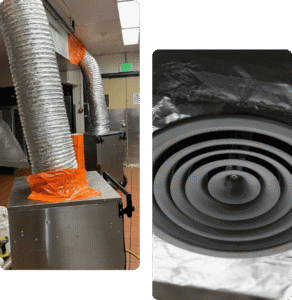
There are two main types of vacuum collection units. Truck-mounted units sit outside the home and pull debris out through a large hose, while portable units are brought inside and placed close to the ductwork. Both can clean to NADCA’s standard. NADCA doesn’t endorse one over the other, and any vacuum collection device that exhausts indoors must be HEPA-filtered. The right choice depends on the home’s layout and access.
| Feature | Truck-Mounted | Portable |
| Location | Outside the home | Inside the home |
| Power | Generally higher | Lower, but placed closer to ducts |
| Exhaust | Outdoors | Indoors through HEPA filters |
| Best For | Larger homes with easy access | Condos, townhomes, limited access |
HEPA Filtration
HEPA filters are what make indoor vacuum equipment safe to use. A true HEPA filter is capable of capturing particulates of 0.3 microns with 99.97% efficiency. Federal guidance on duct cleaning also calls for vacuum equipment that exhausts particles outside of the home, or HEPA vacuuming equipment if the vacuum exhausts inside.
Collection Containers
Everything the vacuum pulls out has to go somewhere. All vacuum units should be attached to a collection device that holds debris for safe containment until disposal, which keeps removed dust from escaping back into the home or yard.
Pressure Gauges
Negative pressure only works if it holds across the system. Technicians use pressure gauges, often called manometers, to confirm the ducts are under steady suction before and during agitation. A drop in pressure can point to an unsealed register or an open access point.
Agitation Tools
Dust in ducts doesn’t just sit loose. Over time, it sticks to duct walls, collects in corners, and builds up at joints and bends. Agitation tools break that buildup free so the vacuum can remove it.
Rotary Brushes
Rotary brushes spin on a flexible cable fed into the ducts. They scrub the inside surfaces as they move through each run:
- Brush Heads: Different sizes match round and rectangular ducts.
- Bristle Types: Stiffer bristles suit bare sheet metal, while soft bristles protect lined or fiberglass ducts.
- Power Source: Electric or air-powered drives spin the cable.
Air Whips
Air whips are flexible hoses with tips that whip around when compressed air flows through them. The movement knocks debris loose from duct walls, especially in corners and around bends where brushes have a harder time reaching.
Skipper Balls
Skipper balls are round attachments with air nozzles that bounce through ductwork under compressed air. They work well in longer runs and branch lines, pushing dust toward the vacuum as they move.
Air Compressors
Compressors power the pneumatic tools above. A steady supply of compressed air keeps air whips, skipper balls, and air nozzles working with enough force to break up stuck debris.
Hand Tools for Registers and Grilles
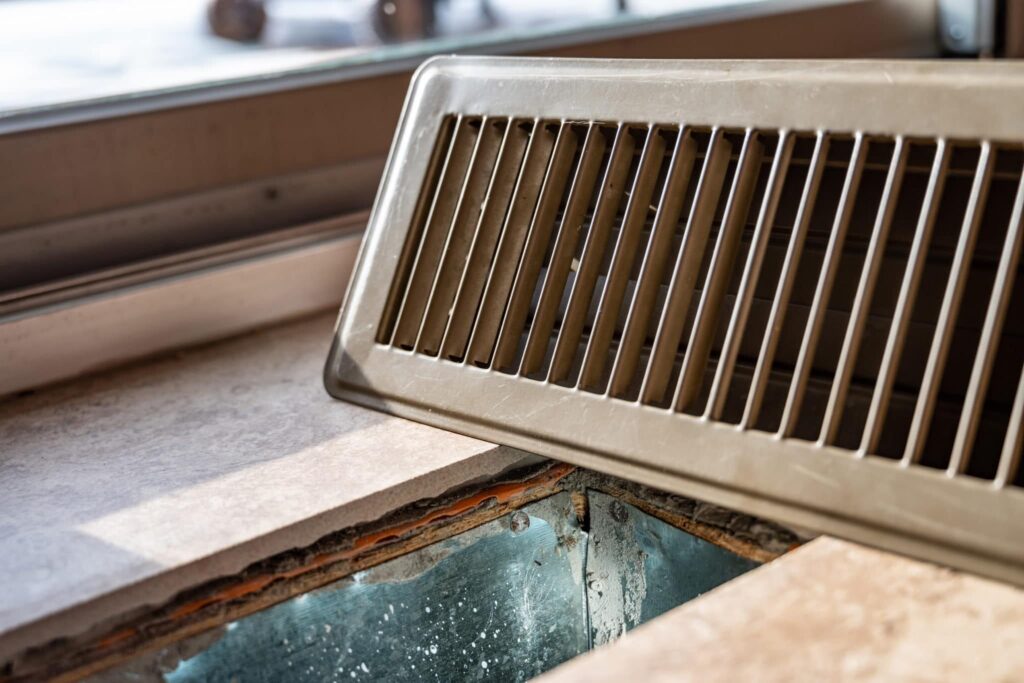
Registers, grilles, and diffusers are cleaned by hand or with contact vacuum attachments. These pieces collect visible dust and are often removed, cleaned, and reinstalled.
Inspection Equipment
Technicians need to see inside the ducts before and after cleaning. Inspection tools show where the buildup is and confirm the job is complete:
- Inspection Cameras: Small cameras on flexible cables show conditions inside duct runs.
- Before and After Photos: Images document what was removed and how the ducts look afterward.
- Flashlights and Mirrors: Help check registers, plenums, and easy-to-reach sections.
Some service providers use remote photography to document conditions inside ducts, which gives homeowners a clear look at results they couldn’t see otherwise.
Access and Home Protection Tools
Cleaning equipment needs a way into the system and a way to keep dust out of the house. These tools handle both jobs:
- Access Hole Tools: Cut small openings in trunk lines for hoses and agitation tools.
- Access Doors and Patches: Seal those openings afterward. EPA guidance calls for sealing and re-insulating access holes so they’re airtight.
- Register Covers and Seals: Block supply and return vents to hold negative pressure inside the system.
- Drop Cloths and Floor Protection: Protect carpet, floors, and furniture during the work.
Before any cleaning starts, the system should also be checked for materials that need special handling, such as older insulation or register boots that may contain asbestos.
Technician Protective Gear
Duct cleaning stirs up dust, debris, and sometimes mold or pest waste. Technicians wear protective gear to work safely inside attics, crawl spaces, and mechanical rooms:
- Respirators or Dust Masks: Protect against fine particles released during agitation.
- Gloves: Protect hands from sharp sheet metal edges and debris.
- Eye Protection: Keeps dust out of the eyes when working overhead.
- Shoe Covers: Keep dirt off floors as technicians move through the home.
Also Read: How Much Does Air Duct Cleaning Cost?
Equipment for Coils, Blowers, and the Air Handler
Ducts are only part of the HVAC system. Dust also collects on the evaporator coil, blower, and drain pan, and these parts need their own tools:
- Coil Cleaners and Sprayers: Loosen dirt packed between coil fins.
- Fin Combs: Straighten bent fins so air can pass through.
- Blower Cleaning Tools: Remove buildup from fan blades and housings.
- Drain Pan Cleaning Supplies: Clear standing water and debris that can feed mold growth.
Dirty coils affect how well the system works. A study on residential air conditioners found that coil fouling increases system pressure drop and decreases system airflow.
At Accurate Duct Cleaning, our coil cleaning service handles this part of the system, which keeps clean ducts from being refilled by a dirty air handler.
Antimicrobial Application Equipment
Foggers and sprayers are sometimes used to apply antimicrobial products. These are optional and not part of a typical cleaning. NADCA notes that antimicrobial products should be applied only after the system has been thoroughly cleaned and must be registered with the EPA for the specific HVAC components where they’re used. No products are currently registered for use on fiberglass duct board or fiberglass-lined ducts.
Matching Equipment to Duct Type
Different duct materials need different tools. Using the wrong brush or too much air pressure can damage the ductwork. EPA guidance calls for soft-bristled brushes on fiberglass duct board and on sheet metal ducts lined with fiberglass. Here’s how equipment choices usually line up:
| Duct Type | Common Equipment | Notes |
| Bare Sheet Metal | Rotary brushes, air whips, skipper balls | Handles firmer agitation |
| Fiberglass Duct Board | Soft-bristle brushes, gentle agitation | Aggressive tools can tear the surface |
| Fiberglass-Lined Metal | Soft-bristle brushes, controlled air tools | Liner must stay intact |
| Flexible Duct | Soft brushes, low-pressure air tools | Damaged sections are often replaced |
Many homes have a mix of these materials, which is why technicians check the ductwork before choosing tools.
Equipment for Commercial and Industrial Systems
Commercial and industrial buildings have larger ducts, longer runs, and bigger air handlers than homes. Cleaning these systems often calls for heavier equipment:
- Larger Vacuum Collection Units: Move enough air to hold negative pressure across large trunk lines.
- Robotic Cleaning Systems: Remote-controlled units with cameras and brushes travel through large ducts that people can’t reach.
- Longer Cable and Hose Systems: Extend agitation tools through long runs.
- Larger Access Doors: Provide entry points sized for bigger equipment.
The basic method stays the same, with negative pressure and agitation working together, but the scale of the equipment grows with the system.
How the Equipment Is Used Step by Step
Seeing the order of the work makes it clear why each tool is needed. A typical cleaning follows these steps:
- Inspect the System: Cameras and flashlights show the condition of ducts, coils, and registers.
- Protect the Home: Floors and furniture near the work area are covered.
- Seal the Registers: Vents are covered to keep negative pressure inside the ducts.
- Connect the Vacuum: The truck-mounted or portable unit is attached to the main trunk line, and a pressure gauge confirms the system is holding negative pressure.
- Agitate Each Duct Run: Brushes, air whips, or skipper balls loosen debris while the vacuum runs and collects it in a sealed container.
- Clean Registers and Grilles: Vent covers are cleaned by hand.
- Clean the Air Handler: Coils, blower, and drain pan are cleaned with their own tools.
- Seal Access Points: Openings are closed and made airtight.
- Inspect Again: Cameras confirm the ducts are visibly clean.
Why a Shop Vac and Household Brushes Aren’t Enough
Household tools can clean registers and the first few inches of a vent, but they can’t clean the duct system:
- No Negative Pressure: A shop vac can’t pull air through an entire duct system.
- Limited Reach: Household brushes don’t reach long trunk lines or branch runs.
- Weak Filtration: Many shop vacs release fine dust back into the room.
- No Inspection: Without cameras, there’s no way to see what’s left inside.
Professional equipment is built to reach the full system and contain what it removes.
Frequently Asked Questions
What is the main machine used for air duct cleaning?
The main machine is a vacuum collection unit, also called a negative air machine. It can be truck-mounted outside the home or portable inside, and it pulls air and debris out of the ducts under negative pressure.
Do duct cleaners use HEPA filters?
Yes, when the vacuum exhausts indoors. Any indoor vacuum collection device should be HEPA filtered. Truck-mounted units exhaust outside the home instead.
Is truck-mounted duct cleaning equipment better than portable equipment?
Not necessarily. Truck-mounted units are generally more powerful, while portable units can be placed closer to the ductwork. Both can clean to NADCA’s standard when used with proper agitation tools.
What are air whips and skipper balls?
Both are agitation tools powered by compressed air. Air whips use whipping hose tips to knock debris loose, while skipper balls bounce through duct runs to dislodge dust and push it toward the vacuum.
Do duct cleaners use robots?
Sometimes, mainly in commercial and industrial buildings. Robotic cleaning systems carry cameras and brushes through large ducts that technicians can’t reach. Most homes are cleaned with cable-driven brushes and air tools instead.
Do duct cleaners need to cut holes in my ducts?
Sometimes. Small access openings may be needed to connect the vacuum or insert tools. These openings should be sealed and made airtight when the job is finished.
Can I clean my air ducts with a shop vac?
No, a shop vac can’t create the negative pressure needed to pull debris from the full duct system. It can clean registers and nearby surfaces, but most of the ductwork stays out of reach.
Are chemicals used during air duct cleaning?
Not usually. Antimicrobial products are optional and are applied only after the system has been cleaned, when there’s a specific need. They must be EPA-registered for the HVAC components where they’re used.
Does duct cleaning equipment damage ductwork?
Not when the right tools are used. Fiberglass and flexible ducts need soft brushes and gentler air pressure, while sheet metal ducts can handle firmer agitation.
Takeaway
Air duct cleaning relies on two core pieces of equipment working together: a vacuum collection unit that keeps the system under negative pressure, and agitation tools that loosen debris from duct walls. HEPA filtration, collection containers, pressure gauges, inspection cameras, access tools, register seals, and coil cleaning equipment complete the job. The right tools also depend on duct material and system size, since fiberglass and flexible ducts need gentler handling and commercial systems need larger equipment. Knowing what this equipment does helps you understand what a complete cleaning looks like and what to expect when a crew arrives.
Accurate Duct Cleaning follows NADCA standards on every job and matches our equipment to each property’s ductwork and access. Our team handles residential, commercial, and industrial systems across Toms River and Ocean County, and our coil cleaning service covers the air handler along with the ducts.
We’re licensed and insured, offer free estimates, and provide 24/7 customer support when you need to schedule air duct cleaning in Toms River. Call (732) 908-2666 or request an estimate to schedule your duct cleaning.