If you run a business that uses a good amount of heating, ventilation, or air-conditioning systems, you need regular air duct cleaning. Whether your concern is for commercial space or lighter use like residential air duct cleaning, the choice between hiring a contractor or doing it in-house can shape costs, quality, and control.
Today, we will be discussing the pros and cons of each approach so you can decide which is right for your business. We’ll look at the key factors: cost, control, expertise, flexibility, and risk. By the end, you should feel more confident choosing between contractor vs in-house duct cleaning.
What We Mean By Contractor vs In-House Duct Cleaning
First, let’s clarify terminology so we’re on the same page.
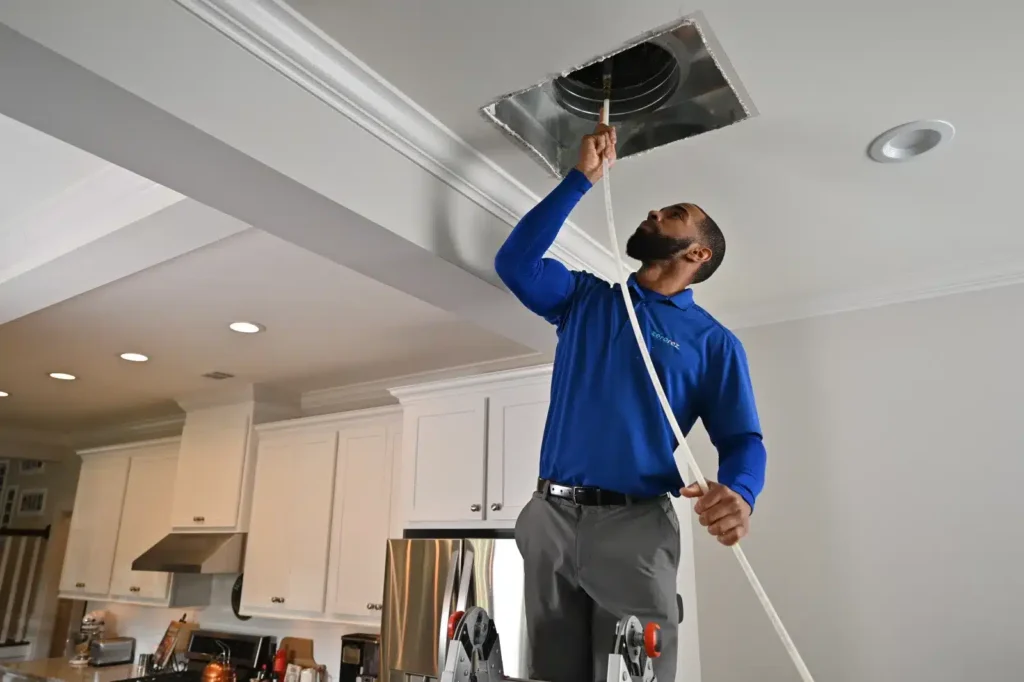
Contractor in this context means you hire an external service provider, a specialised company whose core business includes performing air duct cleaning services. They bring their own equipment, staff, training, and procedures.
In-house means your business uses internal staff or builds a small internal team to carry out duct cleaning, schedule it, train it, and maintain it. You invest in equipment, oversight, and management.
When comparing contractor versus in-house duct cleaning, the decision comes down to outsourcing the task or keeping it internal. Each has trade-offs.
Pro for Contractors: Access to Specialist Expertise & Equipment
One of the strongest benefits of using a contractor is their expertise and equipment. For instance, specialists in air duct cleaning know how to handle duct systems, HVAC components, registers, plenum cavities, and more. The National Air Duct Cleaners Association emphasises that proper duct cleaning requires high-powered vacuums, mechanical agitation, and negative-pressure systems.
When you contract a professional firm, you tap into their accumulated experience. That means fewer mistakes, such as damage to ducts, missed sections, and inadequate vacuuming, compared to an in-house team trying this for the first time.
If you handle residential air duct cleaning and commercial air duct cleaning too, the contractor may already have calibrated procedures for both settings, saving you training time and risk.
Con for Contractors: Lower Control Over Schedule & Standards
Even though contractors bring expertise, you sacrifice some control. When you outsource, you are relying on another organisation’s schedule, staffing, and priorities. If their calendar is full, you might wait. If they outsource subcontractors themselves, your visibility may drop.
And sometimes the contractor may cut corners or use less rigorous methods, especially if the contract didn’t set tight standards. The United States Environmental Protection Agency warns that improperly performed duct-cleaning can actually worsen indoor air quality.
So you get less hands-on control over contractors than with in-house setups.
Pro for In-House: Direct Control, Flexibility & Integration
When you build an in-house duct-cleaning team, you get direct control over the process. You decide the schedule; you set the standards; you can integrate duct cleaning into your overall maintenance programme.
You also benefit from internal alignment: the team works within your organisation, understands your systems, your facilities, and your risk tolerance. This makes coordination simpler.
An in-house setup may be particularly advantageous if you have frequent or recurring needs, as it helps you avoid repeated contractor mobilisation charges.
Also Read: How Air Duct Cleaning Protects Your HVAC System?
Con for In-House: Higher Fixed Costs & Training Burden
While control is strong, the in-house model comes with higher fixed costs and management burden. You must purchase or lease equipment such as powerful vacuums, brushing tools, blower fans for negative pressure, and protective gear. The NADCA notes that proper cleaning isn’t trivial; it involves using trucks or trailers, portable equipment, and negative-pressure systems.
You also need to recruit or train staff, maintain their certifications or skill levels, and oversee the quality. Mistakes cost you; mis-cleaning a duct run may lead to re-work, or worse, damage to the HVAC or duct board.
Another issue: if your business only occasionally needs duct cleaning, say once every few years, the investment may not be justified internally. The EPA says routine cleaning is not always needed unless certain conditions exist.
So the high overhead and the risk of seldom-used items may tilt you toward the contractor.
Cost Comparison: Contractor vs In-House
Let’s break down cost factors with each model:
Contractor Costs:
- You pay for the service when you need it. Mobilisation, labour, materials, equipment.
- You may avoid equipment purchases, training overhead, and long-term staffing costs.
- You may pay a premium if you need urgent service, or if the provider has minimum call-out charges.
In-House Costs:
- Fixed investment: purchase/lease of equipment, protective gear, consumables.
- Staffing costs: salary, training, benefits, downtime, management.
- Ongoing maintenance and replacement of equipment.
- Opportunity cost: your staff working on duct cleaning cannot be doing other tasks.
Quality & Risk Factors: What Can Go Wrong
Quality and risk matter a lot when you do duct cleaning, whether for commercial or residential systems. Let’s look at what can go wrong with each model.
With a contractor:
- They may not inspect your specific system thoroughly; they may apply a standard cleaning without tailoring.
- They may use shortcuts: inadequate debris removal, skipping components. NADCA warns that failing to clean all components can lead to re-contamination.
- They may not coordinate well with your facilities management team, causing downtime or additional disruption.
- There may be liability or warranty issues: if damage happens, whose responsibility?
- If you don’t set the contract scope clearly, you may pay for less than you expected.
With in-house:
- If staff are inexperienced, you risk subpar cleaning or damage to ducts, especially flexible duct and duct board. A pros-and-cons list highlights the risks of damage and the limited benefit if done improperly.
- You may under-train, under-equip, and treat it as maintenance rather than specialised cleaning.
- You may not stay current with best practices like negative pressure and brushing.
- You may underestimate the hidden costs of mistakes.
In both cases, the cleaning may not deliver full benefits unless the root causes, such as dust ingress, moisture, mold, and rodents, are addressed. The EPA emphasises that cleaning alone isn’t automatically a health benefit unless conditions require it.
Which Model Wins In Terms Of Flexibility and Scalability?
When it comes to flexibility and scalability, each model has different strengths.
Contractor:
- High flexibility: you can call them when you need cleaning, scale by size, or schedule at your convenience.
- No long-term commitment: you pay when required.
- If your business grows, with more buildings and more units, the external provider can scale more easily than you hiring more staff.
- People studying outsourcing talk about scalability being a major benefit.
In-House:
- Less flexible: if you need heavy cleaning unexpectedly, your team may lack capacity, and you may need external help anyway.
- If your demand drops, you still carry fixed costs.
- But if your operations are stable and predictable, you know you’ll clean annually or semi-annually, and in-house gives you predictable scheduling.
So for businesses with fluctuating demand, contractor often wins in flexibility; for stable demand, the in-house model can be efficient.
Also read: What’s the Difference Between a Basic and Deep Duct Cleaning?
Specific Considerations for Residential vs Commercial Systems
- Residential systems are typically smaller, simpler, and have less frequent cleaning needs. Here, the contractor makes strong sense because your volume may be lower, and you don’t need large specialised internal equipment.
- Commercial systems are larger, with more frequent cleaning requirements and higher stakes. If you manage many such systems, in-house cleaning offers economies of scale.
When to Use Contractor vs In-House
Here’s a quick guide to help decide:
Ask yourself:
- How often do I need duct cleaning? If only occasionally, the contractor likely makes sense.
- How complex/large are my systems? The bigger/more complex, the more benefit from a specialist contractor or maybe an internal specialist team.
- What budget do I have for equipment, training, and staff overhead? If limited, the contractor wins.
- How important is control and integration with my facility operations? If very important, in‐house may be preferable.
- Do I need flexibility/scalability? Contractor gives an advantage.
- Do I already have skilled maintenance staff, or is this completely new? If new, the starting cost of in-house is high.
- What are the risks if cleaning is done poorly? If risk is high, e.g., health-sensitive environment, high visibility, regulatory scrutiny, ensure you choose the model that gives you quality assurance, which may mean a contractor with strong credentials or a well-trained in‐house team.
Use the answers to these to pick your model. And you might choose a hybrid: for routine residential jobs, you hire a contractor; for in-house light cleans, you maintain minimal capability.
Tips to Maximize Value Regardless of Model
Whether you pick a contractor or an in-house team, you will get better results if you follow these tips:
- Set clear scope: Define what duct cleaning means for your system; covers registers, grills, plenum, blower, coils? Don’t assume.
- Require documentation: If you use a contractor, ask for photos before/after, a component list, vacuum unit data, and credentials of technicians.
- Train staff: If in-house, invest in basic training and keep up-to-date with best practices.
- Maintenance scheduling: Make duct cleaning part of your preventive maintenance — keep logs, schedule inspections.
- Address root causes: For example, dust ingress, moisture, pest intrusion. The EPA emphasises that cleaning alone isn’t enough if the system remains vulnerable.
- Monitor ROI: Track metrics such as improved airflow, reduced energy usage, fewer complaints about air quality, and fewer HVAC failures. Usually, the benefit is clearer if the ducts are badly neglected. If they were already in reasonable shape, gains may be small.
- Choose proper equipment and methods: Especially important for in-house. For example, NADCA notes the use of mechanical agitation and negative pressure vacuum for proper cleaning.
- Be realistic about health claims: Many providers exaggerate. The EPA warns that duct cleaning has not been proven to consistently prevent health problems.
- Budget appropriately: Don’t cut corners on the method just to reduce cost, as poor cleaning may lead to more problems.
Final Verdict
It all boils down to this: the decision between contractor and in-house duct cleaning hinges on your business’s specific needs, scale, budget, risk profile, and desired control.
If you want minimal fixed cost, fewer headaches, and only occasional service, go with a contractor. If you want maximum control, tight integration, and you have frequent or complex cleaning needs, in-house may be better.
Are you looking for a trusted and reliable air duct cleaning company? Contact Accurate Duct Cleaning. We provide expert ductwork cleaning services for commercial and residential properties. Our technicians are well-trained and experienced in handling all sizes of ducts without causing any harm. They deep clean them inside out to achieve the best results.
Call us today and schedule an appointment.